Natural Resource Extraction
Suffolk County is located on the eastern end of Long Island, New York. With an area of 2,373 square miles, surrounded by large bodies of water on 3 sides, sand is an abundant resource for the region. A majority of materials mined in New York State are used in construction to build and maintain state infrastructure such as roads, bridges, and foundations. On a more local scale, the materials can be used for beach and coastline restorations, seen in Figure 1 at the Smith Point Park coastline.1 This is important for Suffolk because they are facing a dangerous rise in sea level paired with more extreme weather conditions, making the coasts much more vulnerable to erosion and storm damage. While forestry is not a major industry in the county, the Pine Barrens are one of the most well known stretches of protected land on Long Island. They are managed by a mix of federal, state, and local public land managers. There are also a few inholdings, or privately owned land areas inside the boundary of the preserve.2 In Suffolk County, sand mining is the dominant form of resource extraction, but tensions have recently surfaced over how both the mines and the ecologically sensitive Pine Barrens are being managed.
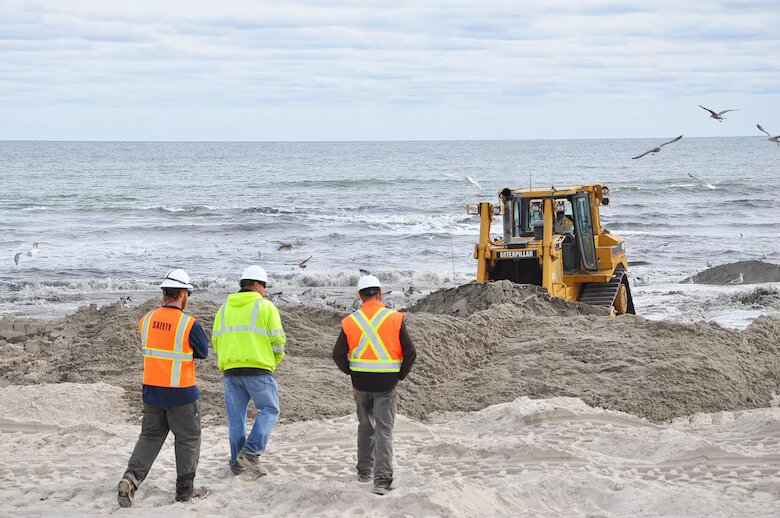
Figure 1.
USACE New York District accomplishes major coastal restoration projects over past three ye. New York District. (2015, October 30). https://www.nan.usace.army.mil/Media/News-Stories/Story-Article-View/Article/626699/usace-new-york-district-accomplishes-major-coastal-restoration-projects-over-pa/
Regulation of mining in New York State was lacking until the instating of the Mined Land Reclamation Law in 1975. This was put in place to monitor the industry by “fostering and encouraging the development of an economically sound and stable mining industry, the orderly development of domestic mineral resources necessary for the economic needs of New York, and mandating the use of sound environmental management practices.” 1 Sand is the second most utilized resource on the planet, yet it is non-renewable. With approximately fifty billion tons extracted annually, the practice is highly unsustainable.3 Suffolk County’s twenty active mines are part of this global trend. Figure 2 shows one of these mines belonging to the Roanoke Sand and Gravel Corporation.
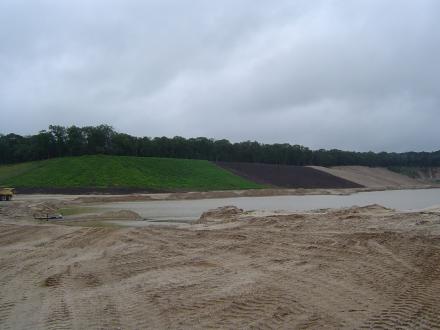
Figure 2.
Mining on long island. Department of Environmental Conservation. (n.d.). https://dec.ny.gov/environmental-protection/mining-reclamation/long-island-mining
In Suffolk County, sand mining is particularly harmful because of its threats to water quality. Being that Suffolk operates on a sole-aquifer system to supply the whole population with drinking water, it’s crucial to maintain its safety. Sand acts as a filter to protect aquifers, and excavations can expose the water to harmful pollutants.4 Figure 3 below shows a mine in Noyack dangerously close to reaching groundwater. Southampton has the largest number of active mines compared to all other Suffolk towns, and they are located on top of an area where rainwater recharges and replenishes the aquifer.4 In December of 2024, the town revealed a new plan to end sand mining in residential areas to combat some of these effects. This will be done via a process called amortization, in which the mines are slowly phased out over the course of a seven year period. Unfortunately, this sparked a large debate between local environmentalists and tradespeople. Mining has played a key role in the economy, and the changes being proposed could devastate construction and mining workers’ business. Southampton community members have complained that this plan unfairly targets middle class and blue-collar workers by eliminating jobs and potential profit. The policy does grant time to mine operators so they may finish any projects already approved by the Department of Environmental Conservation, giving them anywhere from one to seven years depending on the completion level of each project. Appeals for extensions are also available.4
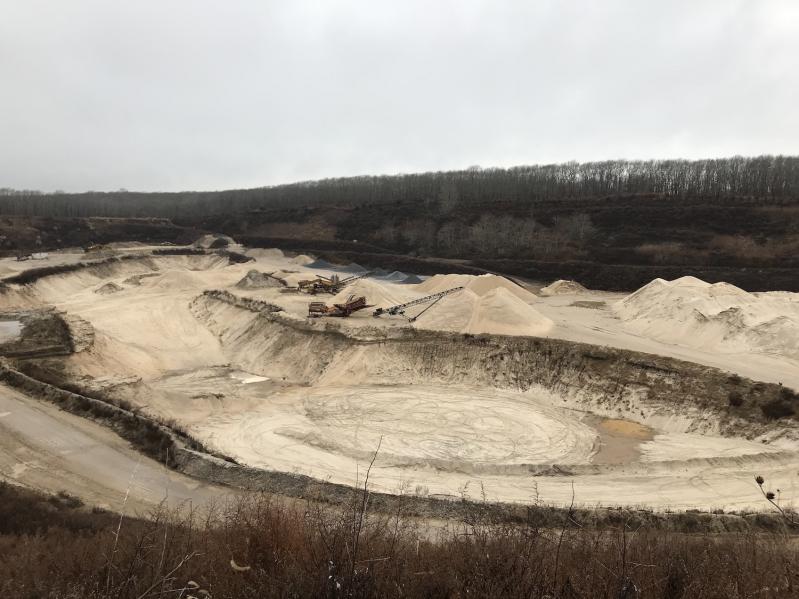
Figure 3.
Gangemi, C. (n.d.). Sand land mine accused of operating illegally. Sand Land Mine Accused of Operating Illegally | The East Hampton Star. https://www.easthamptonstar.com/government/2023105/sand-land-mine-accused-operating-illegally
Reclamation of abandoned mine sites is a solution that Suffolk County has taken to improve the health of surrounding environments and increase quality of life for residents. Out of the total 99 mines of record in the county, about 874 acres have been reclaimed.5 This sounds positive, in theory, however it’s ultimately dependent on what the sites are being turned into. A popular example of this is the Harbor Links golf course, which opened almost thirty years ago. There was a wide stretch of destroyed land that developer Michael Hurdzan viewed as an opportunity: “We didn’t have to worry about things like taking down trees. The land was already destroyed. We were going to put it back together” (Figure 4).6
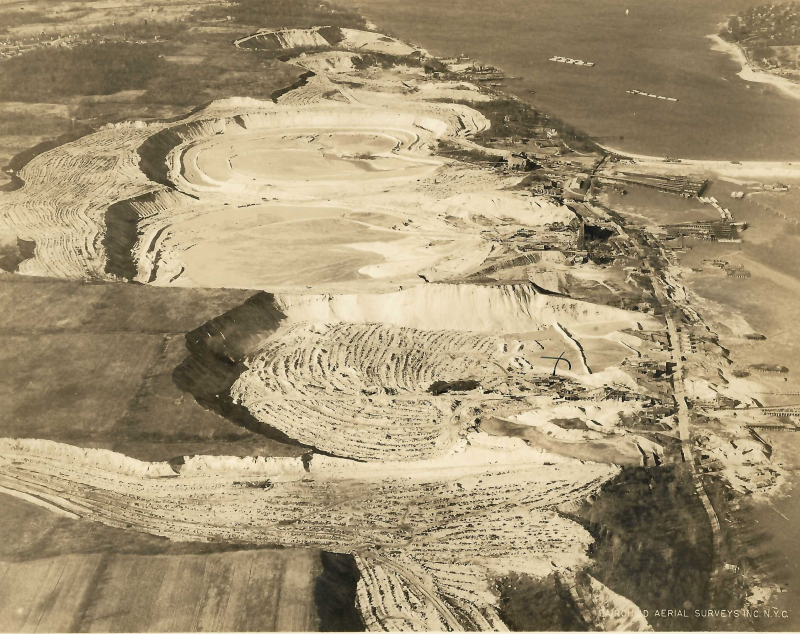
Figure 4.
Golf on Long Island: Harbor links approaching 25 years since its grand opening in a Port Washington Sand mine. (n.d.). https://www.golfonlongisland.com/teebox/2023/07/harbor-links-approaching-25-years-since-its-grand-opening-in-a-port-washington-sand-mine.html
Golf courses are not largely considered sustainable entities. A typical course utilizes copious amounts of water, as well as pesticides to maintain the pristine look and visual appeal. Harbor Links, however, is committed to the health of the surrounding ecosystems, landing them a spot as the twenty-ninth member of the Audubon International Signature Program. This is possible through the implementation of a natural resource management program that addresses “wildlife conservation and habitat enhancement, water quality monitoring and management, integrated pest management, water conservation, energy efficiency, and waste management.” 7 Hurdzan is known for his work on environmentally sound golf courses and Harbor Links in specific features native grasses, wildlife habitats, and fifty acres of wetlands. This reclamation offers a successful and sustainable solution for the environmental damage caused by abandoned mine sites. It prioritizes the state of the environment while also stimulating the economy and creating a sense of community for residents.
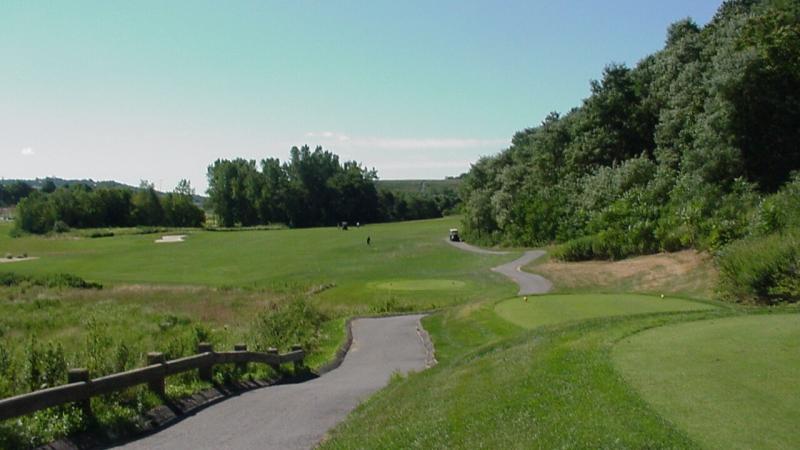
Figure 5.
Mining on long island. Department of Environmental Conservation. (n.d.). https://dec.ny.gov/environmental-protection/mining-reclamation/long-island-mining
The Suffolk County Pine Barrens cover over one hundred thousand acres, and is considered Long Island’s largest natural area.2 The land is protected under the 1993 Long Island Pine Barrens Protection Act, which permits any development in over half of its area. The rest of the land is only to be developed on environmentally compatible projects.2 The towns in which the Pine Barrens are spread throughout are Brookhaven, Riverhead, Southampton, and East Hampton. Large portions of the land are separated by major highways. The center of the Pine Barrens covers a portion of the Suffolk aquifer, where the land is able to recharge the drinking water source. The groundwater in this area is also particularly pure, and “several land programs are in place to preserve and protect the Pine Barrens as both a unique ecosystem and for its ability to recharge groundwater.” 8 The Barrens play a vital role in maintaining the health of Suffolk County, providing numerous ecosystem services that support the area’s well being.

Figure 6.
WSHU. (2021, October 19). The pine barrens – long island’s nature sanctuary. https://www.wshu.org/news/2019-09-10/the-pine-barrens-long-islands-nature-sanctuary
Although the Pine Barrens are an essential part of Suffolk County’s ecosystem, managing them has proven to be extremely challenging. The trees are very severely infested with southern pine beetles, one of the most destructive insect pests of pine trees.9 These beetles have led to most of the tree cover dying out, resulting in thousands of acres of dead tree material. This material, combined with dry weather, wind, and other circumstances has led to four major wildfires in the past thirty six years. The most recent event was this past March of 2025.
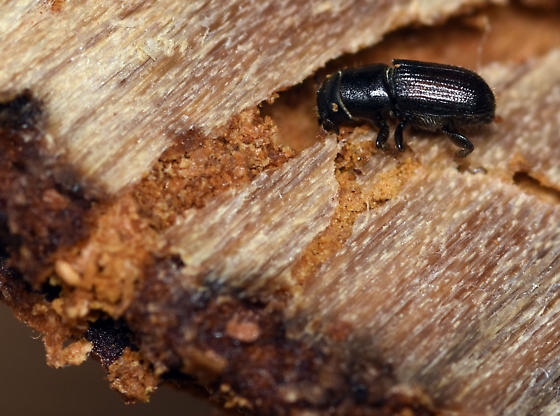
Figure 7.
Southern Pine beetle – dendroctonus frontalis. Welcome to BugGuide.Net! – BugGuide.Net. (n.d.). https://bugguide.net/node/view/2315701
To combat this, in January of 2025, representative Nick LaLota issued a statement in support of the Fix Our Forests Act. This included his provisions that addressed the beetle infestation and called for a “comprehensive study of the causes, effects, and potential solutions for pine beetle outbreaks.”10 Unfortunately, just a month later a large fire broke out, sweeping through hundreds of acres of the region. The fire allegedly started by someone attempting to make s’mores in their backyard, unaware of just how combustible the dead materials in the surrounding area were. Forty five mile per hour winds spread the embers from Manorville all the way to the Hamptons.11 Figure 8 depicts emergency responders at the scene of one of the fire’s locations. There were four separate fires burning simultaneously responded to by over six hundred firefighters and eighty Suffolk County volunteer fire departments.
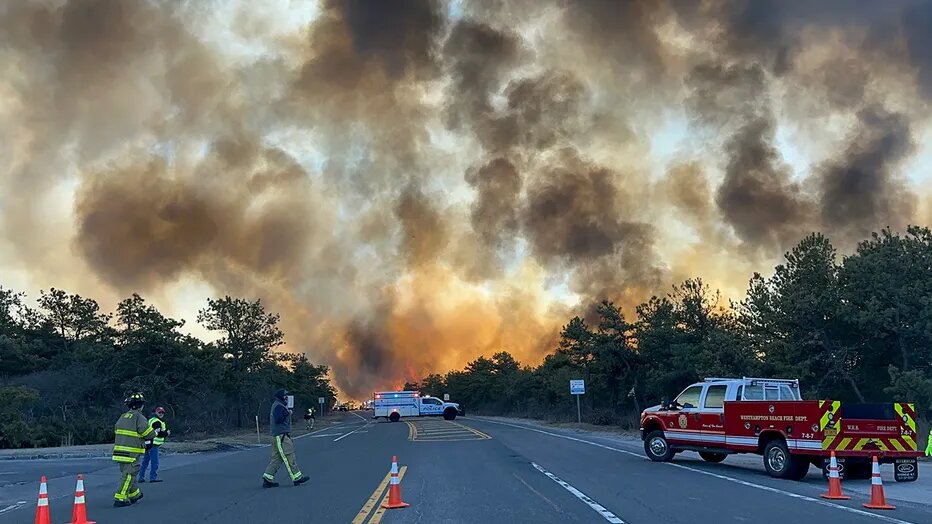
Figure 8.
Meier, A. (2025, March 9). Long Island Brush Fire: Crews knock down blaze but wind threats remain. FOX 5 New York. https://www.fox5ny.com/news/long-island-brush-fire-update
The March 2025 fire could have been significantly worse if not for the quick and dedicated work of Suffolk firefighters and volunteers. Early into their ignition, reports worried that it would end up being comparable to the 1995 wildfires, the largest the state had seen in over ninety years, taking four days to contain.12 The fires burned on both sides of Sunrise Highway, one half of Long Island Route 27: “The Sunrise Fire scorched 4,500 acres of pine barrens…It damaged about a dozen homes before it was put out by firefighters from across the state.” 12 This is pictured below in Figure 9.
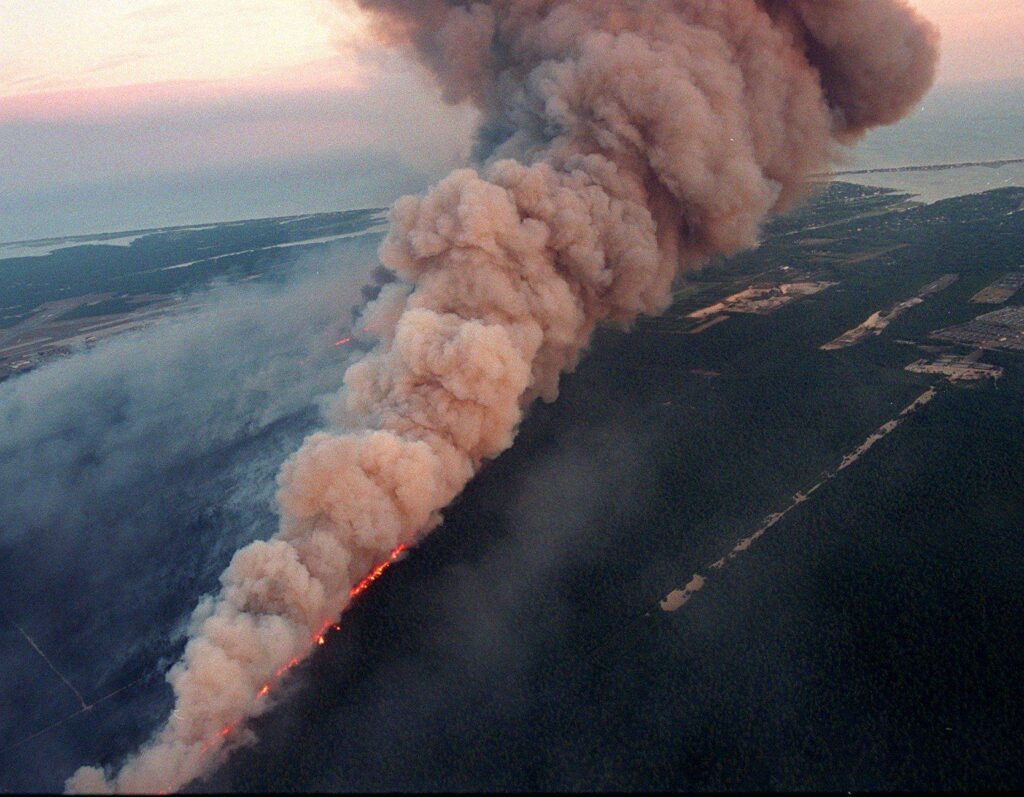
Figure 9.
Battleground: The sunrise fire of 1995. (n.d.). https://projects.news12.com/battleground:-the-sunrise-fire-of-1995/
Sand mining and Pine Barren management involve a variety of stakeholders in the county. Mining companies and their employees are at risk of losing profit as well as their jobs, jeopardizing the well being of them and their families. Environmental organizations are prioritizing the health of the land, while also recognizing that they don’t want anyone to suffer or experience a loss because of implemented changes. Homeowners near the mines and Pine Barrens are also in a dangerous position, as they are at risk of toxic chemical exposure and property damage from wildfires on a daily basis. Government agencies on a local and state level are in charge of monitoring changes and managing the land as well as the people. This includes aquifer workers, firefighters, and emergency responders.
I’ve explored the solutions being put in place, from the seven-year plan to halt mining near residential areas, to golf course reclamation, to proposed policies aimed at protecting the Pine Barrens, but each comes with its own set of challenges. People do not want to get rid of mines because they provide jobs and fuel the local economy. Certain politicians like Republican Cyndi McNamara worry about running out of sand, and how that might negatively affect budgets and spending.4 As with any kind of large-scale management, the costs associated with forest control and fighting wildfires are tremendous. Though the act proposed would help combat the pine beetle infestation in the Pine Barrens, running the study would be very expensive. Regarding fires alone, the country as a whole spends about 2.9 billion dollars annually to suppress wildfires.13
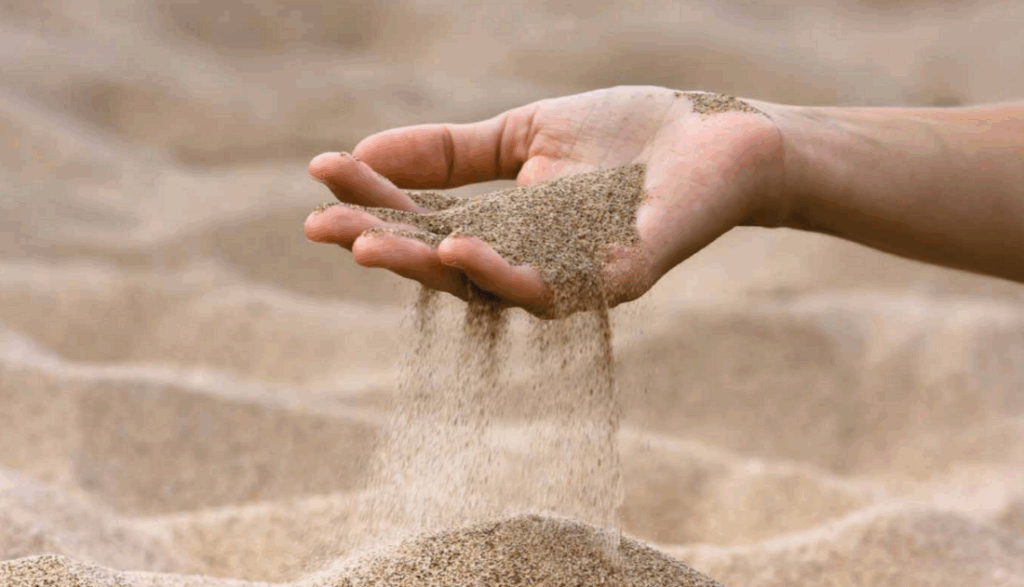
Figure 10.
Specialized binders improve resource conservation in Foundries. News. (n.d.). https://www.ha-group.com/en/media/news-technical-articles/detail/specialized-binders-improve-resource-conservation-in-foundries/
Although these challenges are complex, the solutions we’ve implemented have proven effective based on our sustainability goals. We emphasize the importance of allocating resources in ways that address the environmental, social, and economic needs of both current and future generations. For example, the Harbor Links golf course supports environmental sustainability by minimizing all forms of waste and preserving surrounding habitats. Socially, it acts as a community hub, offering a space for recreation and connection. The plan to ban sand mining protects nearby households while also allowing mining companies sufficient time to complete their projects, helping to avoid economic disruption. Meanwhile, the proposal to address pine beetle outbreaks in the Pine Barrens is designed to prevent wildfires and further ecological harm in Suffolk County. This last initiative is still in the early stages and requires further local action. Overall, Suffolk County is actively working to find a balance between resource use and its environmental, social, and economic impacts.
References
- Mining on long island. Department of Environmental Conservation. (n.d.). https://dec.ny.gov/environmental-protection/mining-reclamation/long-island-mining
- Wikimedia Foundation. (2025, April 2). Long island central pine barrens. Wikipedia. https://en.wikipedia.org/wiki/Long_Island_Central_Pine_Barrens
- The problem with our dwindling sand reserves. UNEP. (n.d.). https://www.unep.org/news-and-stories/story/problem-our-dwindling-sand-reserves
- Winter, K. (2025, January 23). Southampton’s proposal to close sand mines near Homes Divides Town. Citizens Campaign for the Environment. https://www.citizenscampaign.org/whats-new-at-cce/2025/1/22/southamptons-proposal-to-close-sand-mines-near-homes-divides-town#:~:text=Environmentalists%20say%20sand%20mining%20is,harmful%20pollutants%2C%20environmentalists%20have%20said
- Suffolk County Mined Land reclamation summary report. New York State Mined Land Reclamation Database. (n.d.). https://extapps.dec.ny.gov/cfmx/extapps/MinedLand/standard/ml_summaries/index.cfm?CountyNo=102
- Golf on Long Island: Harbor links approaching 25 years since its grand opening in a Port Washington Sand mine. (n.d.). https://www.golfonlongisland.com/teebox/2023/07/harbor-links-approaching-25-years-since-its-grand-opening-in-a-port-washington-sand-mine.html
- Audubon Program – Harbor Links Golf Course. Harbor Links Golf Links. (2025, January 7). https://www.harborlinks.com/audubon-program/
- Groundwater Water Source. BNL. (n.d.). https://www.bnl.gov/water/groundwater.php
- USDA. Forest Insect & Disease Leaflet. (n.d.). https://www.fs.usda.gov/Internet/FSE_DOCUMENTS/fsbdev2_042840.pdf
- Lalota votes to protect Long Island Pine Barrens. Congressman Nick LaLota. (2025, January 24). https://lalota.house.gov/media/press-releases/lalota-votes-protect-long-island-pine-barrens
- ABC News Network. (n.d.). ABC News. https://abcnews.go.com/US/long-island-new-york-wildfires-suspected-cause/story?id=119629135
- Long Island wildfires: 3 times the Pine Barrens have burned. Home -. (n.d.). https://www.pinebarrens.org/long-island-wildfires-3-times-the-pine-barrens-have-burned/
- Sarah Farmer and Jenni Moore Myers. (n.d.). Economic risks: Forest service estimates costs of fighting wildfires in a hotter future. US Forest Service Research and Development. https://research.fs.usda.gov/srs/products/compasslive/economic-risks-forest-service-estimates-costs-fighting-wildfires-hotter#:~:text=Wildfire%20suppression%20is%20costly.,of%20%242.9%20billion%20per%20year.&text=Wildfires%20and%20the%20cost%20of,while%20maintaining%20fire%2Ddependent%20ecosystems
- USACE New York District accomplishes major coastal restoration projects over past three ye. New York District. (2015, October 30). https://www.nan.usace.army.mil/Media/News-Stories/Story-Article-View/Article/626699/usace-new-york-district-accomplishes-major-coastal-restoration-projects-over-pa/
- Gangemi, C. (n.d.). Sand land mine accused of operating illegally. Sand Land Mine Accused of Operating Illegally | The East Hampton Star. https://www.easthamptonstar.com/government/2023105/sand-land-mine-accused-operating-illegally
- WSHU. (2021, October 19). The pine barrens – long island’s nature sanctuary. https://www.wshu.org/news/2019-09-10/the-pine-barrens-long-islands-nature-sanctuary
- Southern Pine beetle – dendroctonus frontalis. Welcome to BugGuide.Net! – BugGuide.Net. (n.d.). https://bugguide.net/node/view/2315701
- Meier, A. (2025, March 9). Long Island Brush Fire: Crews knock down blaze but wind threats remain. FOX 5 New York. https://www.fox5ny.com/news/long-island-brush-fire-update
- Battleground: The sunrise fire of 1995. (n.d.). https://projects.news12.com/battleground:-the-sunrise-fire-of-1995/
- Specialized binders improve resource conservation in Foundries. News. (n.d.). https://www.ha-group.com/en/media/news-technical-articles/detail/specialized-binders-improve-resource-conservation-in-foundries/