Suffolk County, NY: An Introduction
Location
A sustainable entity can be defined as something that meets the social, economic, and environmental needs of present and future generations through three different strategies. First, through the maximization of the standard of human well-being that ensures human rights, social justice for all, and justly protects human health. Secondly, through economic opportunity and development that promotes equitability and empowerment by eliminating the exploitation of people and the environment. And finally, through the extraction, consumption, and regeneration of natural resources in ways that maximize renewal, protection, and restoration of the health of natural systems, biodiversity preservation, pollution reduction, and tackle the climate crisis.
The best practices for meeting these objectives include using transparent processes that engage a diversity of stakeholders, consider the intersectionality of sustainability, employ systems thinking, are based on cultural practices and current scientific information, empower individual and collective action, and use measurable indicators to assess progress and ensure accountability.
In my research throughout this semester, I will examine the ways in which Suffolk County, New York has made progress in achieving sustainability as per this definition by exploring its sustainability initiatives across various sectors. In this essay, I will provide context by presenting information on Suffolk’s geographic and demographic composition, historical background, local government and services, natural resources, and economy.
Geography
Suffolk County is the easternmost county in New York State, located on Long Island, the extreme southeast of the state. A county is an administrative or political subdivision of a state that has specific geographic boundaries and some level of governmental authority2. Suffolk is divided into ten different towns; Babylon, Brookhaven, East Hampton, Huntington, Islip, Riverhead, Shelter Island, Smithtown, Southampton, and Southold. The county population is 1,518,366 people as of the year 20249, with Brookhaven being the most populous. Its geographic makeup is unique, being that it is mostly water.

Figure 1
Sullivan, P. (2020, December 15). Road tripping: Autumn on the East Coast. The Surfers View. https://thesurfersview.com/travel/road-tripping-autumn-on-the-east-coast/
The county is 2,373 square miles in total; 912 of land and 1,461 of water. The east end of Suffolk County splits into two peninsulas, the north and south forks, and the Island as a whole is almost entirely surrounded by bodies of water including the Atlantic Ocean and the Long Island Sound. The eastern end, where I’m from, features large bays and numerous beaches, creating a personal connection that influenced my choice of this research location. Growing up in Suffolk County has given me the opportunity to observe its transformations over the past two decades. I look forward to exploring these changes further, as they’ve had both positive and negative effects on my town and the surrounding communities.
History & Population
Suffolk County is named after the city of Suffolk in England, where its earliest settlers came from. The region was occupied by Montauk Native Americans when these white settlers began arriving and taking over the land. Today, there are two designated reservations for the Suffolk native population; the Shinnecock reservation in Southampton and the Poospatuck reservation in Brookhaven, both Algonquian territories10.
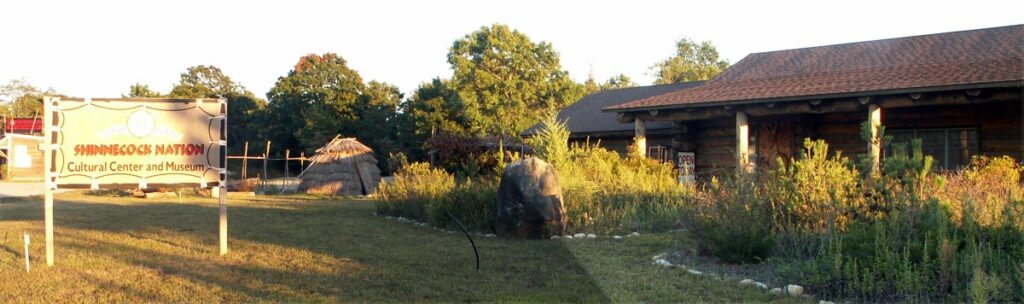
Figure 2
By w:en:Americasroof (talk | contribs) – Own work by the original uploader, CC BY-SA 3.0, https://commons.wikimedia.org/w/index.php?curid=52324794
Suffolk was an original county of the Province of New York, or one of the twelve provinces created in 168319. There are approximately 1,674 persons per square mile, and it is the fourth most populated county in the entire state of New York9. This high population density and proximity to New York City has created a diverse economy for the region. This economy includes industry, science, agriculture, fishery, and tourism2. In a research study performed in 2002, it was found that Suffolk county possessed “significant inequalities of opportunity across racial and economic lines” 11. It was deemed one of the most racially segregated metropolitan areas in the US, overlapping with areas of concentrated poverty11. Now over two decades later, the county remains dominated by its white population at 82.5 percent of the total population, however the Hispanic/Latino population has roughly doubled since then, now at 23.1 percent. Roughly fifteen percent of Suffolk County’s total population is made up by Black, Native American, and/or Asian individuals. Though slightly improved over the years, Suffolk remains a predominantly white region, having implications for a multitude of other factors, such as housing and food, education, and healthcare access.
Government
The overall structure of Suffolk County’s government is similar to that of other counties across the country. There are multiple elected officials that administer and enforce state and local laws, collect taxes, and provide other vital programs and services to support the community12. Suffolk’s government operates as a democracy, historically leaning red. There were about two decades between the 90’s and the 2010’s in which the county voted blue, however the majority was back to being republican by the time of Trump’s first presidency. Suffolk County’s appointed executive is republican Edward P. Romaine, elected in November of 2023. He had served in local government previously for over forty years, most recently prior to his election, he was the Brookhaven Town supervisor. Romaine’s top concerns are environmental protection, public safety, and improving quality of life for Suffolk residents. He wants to preserve as much open and green space as possible, moving away from the use of fossil fuels, and aims to treat wastewater by expanding sewers and septic systems13. Suffolk has its own county legislature with two separate offices. Elected legislators have the power to create laws for the county. Kevin McCaffrey is serving his fourth term as presiding officer for the county14.
There has been recent conflict regarding the districting of Suffolk County voters, creating tension between the political parties and communities across all ten towns. Recently, however, a new bipartisan districting map has been adopted, contrasting these partisan struggles on the issue of gerrymandering and voting fairness. The county legislature held over fourteen meetings among their Redistricting Commission prior to agreeing on a final map, and once unanimously passed, it was signed into law to be taken into effect for the November 2023 elections5.
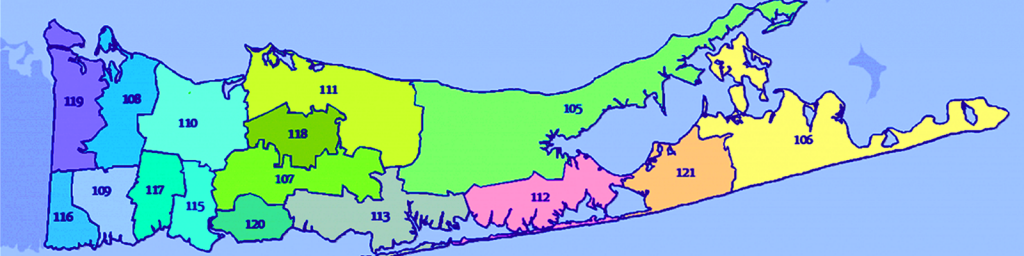
Figure 3
Districts. Suffolk County General Service. (n.d.). https://aasuffolkgs-ny.org/districts/
Suffolk County offers countless government services, ranging from education and social services to online sites designed to simplify the bill paying and business certification processes. Public education and transportation are supported and funded by local government as well as taxpayer dollars. There are many emergency services, such as fire rescue, first responders, hospitals, home protection systems, and storm damage recovery programs18. The county is also committed to supporting individuals facing housing instability and food insecurity through housing assistance programs and food pantries. Social services offers an emergency rental program for the entirety of New York State, and Suffolk specifically lists many community based housing programs on their government website18. The Department of Public Works is Suffolk County’s largest infrastructure-focused agency, responsible for building, maintaining, and operating infrastructure such as bridges, roads, and waterways18.
Economy
Suffolk was previously considered the biggest agricultural county in New York State. It is dominated by traditional family farms and wineries throughout the rural east end which contribute to this title1. In addition to agricultural production, it hosts scientific innovations at Brookhaven National Laboratory, a U.S. Department of Energy facility, and physics and astrophysics research at Stony Brook University. When analyzing the economic behavior further, it is helpful to look at Long Island as a whole. The island is considered one of the world’s “most urbanized and highly developed islands” 15. Both Suffolk and its neighboring county Nassau are renowned for their high standard of living and level of wealth. By national standards, it is extremely costly to live on Long Island15. Some of the most expensive homes in the country are located on the east end, commonly referred to as the Hamptons. In Suffolk County specifically, the median household income is 128,329 dollars, with 579,334 members of the population being employed. Wholesale and retail trade as well as manufacturing are also large economic activities occurring in the region.
Six percent of the total population of Suffolk County is considered to be in poverty21. It is crucial to recognize the significant role of intersectionality in this, as the poverty rates among Hispanic and/or Latino and African American populations are two to three times higher, respectively, than those of the white population. There is also a large gap between the median income of male and female employees who have only earned a high school diploma, and 19.7 percent of families have a female head of household with children living below the poverty line.

Figure 4
NYSCOMMUNITYACTION. (n.d.). https://www.nyscommunityaction.org/assets/docs/Suffolk%20(5).pdf
Natural Resources
Suffolk County’s most precious resource is water. There is an aquifer located below the entirety of Long Island that is the sole source of drinking water for both county’s residents18. Surface water is water located on top of land, and a majority of it is produced by precipitation such as rain and snowmelt25. Suffolk’s surface waters are used for food production, bathing, and recreation. While they utilize this resource, the Department of Health Services, in charge of enforcing water regulation laws, also carries out research and development to find alternatives to the community water supply as well as educating on the importance of groundwater management and protection18. The county requires the use of “all available practical methods to prevent water pollution from sewage, industrial and other wastes, toxic or hazardous materials, and storm water runoff18.
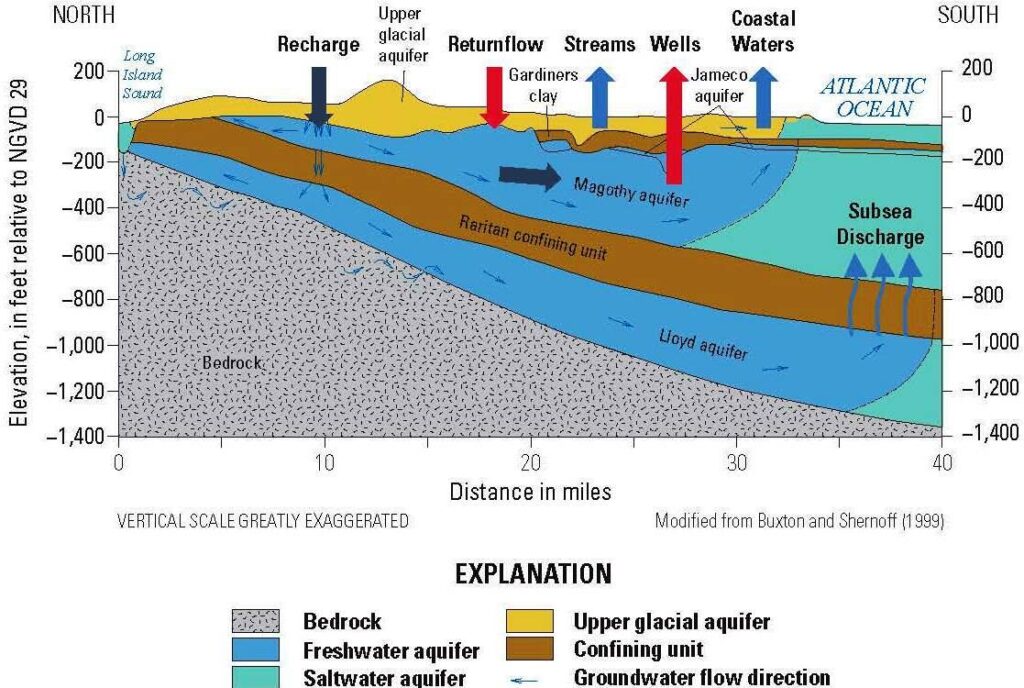
Figure 5
Long Island Sole-Source Aquifer System. USGS. (n.d.). https://www.usgs.gov/media/images/long-island-sole-source-aquifer-system
Education
Education is widely available in Suffolk County. There are currently over 218 thousand K-12 enrolled public school students throughout 69 school districts in the county3. The student population is largely white and Hispanic/Latino, and there is a nearly equal gender ratio, slightly favoring male students. There are also ten higher education institutions present. New York State institutions are funded by three sources; the federal government (4 percent), the state (40 percent), and local tax revenue (56 percent)4. Despite the numerous schools throughout the region, educational inequality still persists. 44 percent of all Suffolk students are currently economically disadvantaged. These students are defined as being “from families receiving public aid, living in institutions for neglected or delinquent children, being supported in foster homes with public funds, or eligible to receive free or reduced-price lunches” 28. In Suffolk County, these disparities are predominantly wealth-based. Out of every school district, only eight schools reported receiving funding for capital projects. This is reflected not only in the access to education, but in its quality, too.

Figure 6
Education/early childhood. Welcome to Suffolk County Community College – Home of the Sharks. (n.d.). https://www.sunysuffolk.edu/explore-academics/majors-and-programs/education/index.jsp
Schools in affluent, predominantly white towns often have access to resources like smart boards, laptops, and other tools that may go unnoticed but significantly enhance the learning environment. For example, Shoreham-Wading River, with a very small minority population, receives over five thousand dollars in funding per student. In contrast, Brentwood, which has a larger minority population, receives only about twenty-three dollars per student17. These disparities directly affect student success and graduation rates. Shoreham-Wading River ranks in the 90th percentile for graduation rates, while Brentwood has reached a high of just 78 percent.
Healthcare
Long Island as a whole has a reputation as a wealthy suburb with excellent healthcare access. The Department of Health Services in Suffolk includes patient care, public health, preventive medicine, services for children with special needs, mental hygiene, environmental quality, emergency preparedness, and business resources18. These programs and services are funded by federal and state government, Medicaid, and county appropriations7. Despite this, those living in poverty, many from minority groups “who also suffer disproportionately from heart disease & strokes, cancer, HIV/AIDS, diabetes, hypertension, and higher infant mortality rates” 18 do not have access to such quality care. Thus, the Suffolk County Office of Minority Health was created. Its mission is to address these disparities and improve the health of minorities. They create new access to primary care services and health insurance in a culturally sensitive manner18. The county is making an effort to acknowledge and mitigate the inequality in healthcare access throughout its population.
Figure 7
Departments. Suffolk County Government seal. (n.d.-a). https://www.suffolkcountyny.gov/Departments/Health-Services/Health-Commissioner/Office-of-Minority-Health
Sustainability Commitment
Suffolk County has a handful of programs and initiatives dedicated to preserving the environment. Several agencies address sustainability concerns in the county, including the Energy and Climate Action Office, the Energy Initiatives Working Group, and the Cleaner Greener Long Island plan. There are over 91 parks and nature preserves in the county, most of which are accessible to the public29. These spaces range from parks and bays to designated conservation areas and nature preserves such as Edgewood Oak Brush Plains Preserve and Elizabeth A. Morton National Wildlife Refuge. Also present are centers for learning that teach young children about the benefits of protecting the planet. The local government has a Soil and Water Conservation District made up of individuals with a diverse level of expertise and knowledge: “The District’s dedication has been established by increased assistance provided to the agricultural community, private landowners and municipalities, and by the many partnerships [they] established with various local, county, state, and federal governmental agencies” 18. The county government has published a series of policies targeting energy and water use, as well as addressing the importance of a climate action plan. They aim to reduce energy use and costs while achieving lower carbon emissions, protect water from the Long Island aquifer, and create a regional sustainability plan that is “framed by goals and guided by implementation strategies that promote community and region wide benefit” 18.
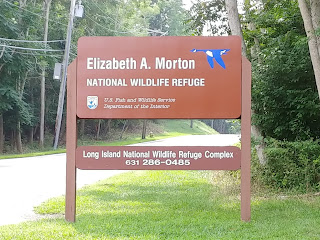
Figure 8
A Mike who likes to hike. A Mike Who Likes to Hike. (n.d.). https://amikewholikestohike.blogspot.com/p/elizabeth-a.html
Conclusion
According to our class definition, something is sustainable if it meets the social, economic, and environmental needs of present and future generations through different strategies. Safeguarding human rights and health, fostering equitable economic development, and managing resources to promote renewal and resilience should be guided by principles of transparency, stakeholder engagement, cultural sensitivity, scientific grounding, and measurable accountability. Through my research, I plan to explore how Suffolk County, New York aligns with our definition of sustainability. I will examine its initiative within the context of its unique geographic, demographic, historical, and economic landscape. I anticipate further looking into the county’s governmental management of natural resources like the Long Island aquifer, and seeing how these resources intersect with and influence economic activity and community quality of life.
Bibliography
- Suffolk. The State of New York. (n.d.). https://www.ny.gov/counties/suffolk#:~:text=The%20eastern%20end%20of%20the,eastern%20end%20contains%20large%20bays
- Wikimedia Foundation. (2025, February 4). Suffolk County, New York. Wikipedia. https://en.wikipedia.org/wiki/Suffolk_County,_New_York
- Suffolk County: Nysed Data Site. data.nysed.gov. (n.d.). https://data.nysed.gov/profile.php?county=58
- Perry, A. (2024, December 20). Understanding foundation aid: How public school funding works in New York State. Fiscal Policy Institute. https://fiscalpolicy.org/understanding-foundation-aid-how-public-school-funding-works-in-new-york-state#:~:text=Overview%20of%20public%20school%20funding,40%20percent%20of%20school%20funding
- Demetropoulos, M. (2022, November 28). Suffolk approves new, Bipartisan Legislature Map. theleader. https://www.thenorthshoreleader.com/single-post/suffolk-approves-new-bipartisan-legislature-map
- Suffolk County Government. Suffolk County Government seal. (n.d.). https://www.suffolkcountyny.gov/
- How are local public health services financed?. UNC School of Government. (n.d.). https://www.sog.unc.edu/resources/faqs/how-are-local-public-health-services-financed
- Departments. Suffolk County Government seal. (n.d.). https://www.suffolkcountyny.gov/Departments/Economic-Development-and-Planning/Planning-and-Environment/Energy-and-Climate-Action
- New York counties by population. World Population Review. (n.d.). https://worldpopulationreview.com/us-counties/new-york
- Indigenous nations and territories in NYS: What we do: NYSCADV. New York State Coalition Against DoNew York Counties by Population (2024)mestic Violence. (n.d.). https://www.nyscadv.org/what-we-do/projects-resources/domestic-violence-indigenous-peoples/recognized-indigenous-nations-and-territories-in-new-york-state.html
- Racism and the opportunity divide on Long Island. ERASE Racism Initiative of the Long Island Community Foundation. (n.d.). http://eraseracismny.org/storage/documents/education/IRP_Full_Report_with_Maps.pdf
- County facts. New York State Association of Counties. (n.d.). https://www.nysac.org/about-us/county-facts/
- Edward P. Romaine. Newsday. (n.d.). https://projects.newsday.com/voters-guide/profile/edward-p-romaine
- A message from Kevin. A Message From Kevin | Suffolk County Legislature, NY. (n.d.). https://www.scnylegislature.us/167/Kevin-J-McCaffrey
- Wikimedia Foundation. (2024, July 12). Economy of long island. Wikipedia. https://en.wikipedia.org/wiki/Economy_of_Long_Island
- Supporting economically disadvantaged students – ICSPS. (n.d.). https://icsps.illinoisstate.edu/images/pdfs/CTE/Special_Populations_Resources/Super_Strategies/Economically_Disadvantaged_ISBE.pdf
- CBS Interactive. (n.d.). Disparities in race, and wealth, impacting how much public school funding certain districts receive. CBS News. https://www.cbsnews.com/newyork/news/disparities-in-race-and-wealth-impacting-how-much-public-school-funding-certain-districts-receive/
- Departments. Suffolk County Government seal. (n.d.). https://www.suffolkcountyny.gov/Departments/Health-Services/Health-Commissioner/Office-of-Minority-Health#:~:text=Suffolk%20is%20also%20surprisingly%20diverse,of%20their%20quality%20of%20life.&text=Based%20on%202010%20Census%20data
- Scaaab. SCAAAB. (n.d.). https://suffolkcountyaaab.org/
- Sullivan, P. (2020, December 15). Road tripping: Autumn on the East Coast. The Surfers View. https://thesurfersview.com/travel/road-tripping-autumn-on-the-east-coast/
- NYSCOMMUNITYACTION. (n.d.). https://www.nyscommunityaction.org/assets/docs/Suffolk%20(5).pdf
- By w:en:Americasroof (talk | contribs) – Own work by the original uploader, CC BY-SA 3.0, https://commons.wikimedia.org/w/index.php?curid=52324794
- Districts. Suffolk County General Service. (n.d.). https://aasuffolkgs-ny.org/districts/
- Long Island Sole-Source Aquifer System. USGS. (n.d.). https://www.usgs.gov/media/images/long-island-sole-source-aquifer-system
- Wikimedia Foundation. (2024, December 27). Surface water. Wikipedia. https://en.wikipedia.org/wiki/Surface_water
- Education/early childhood. Welcome to Suffolk County Community College – Home of the Sharks. (n.d.). https://www.sunysuffolk.edu/explore-academics/majors-and-programs/education/index.jsp
- A Mike who likes to hike. A Mike Who Likes to Hike. (n.d.). https://amikewholikestohike.blogspot.com/p/elizabeth-a.html
- Every student succeeds act (ESSA). U.S. Department of Education. (n.d.). https://www.ed.gov/laws-and-policy/laws-preschool-grade-12-education/every-student-succeeds-act-essa
- https://www.shinnecock-nsn.gov/